
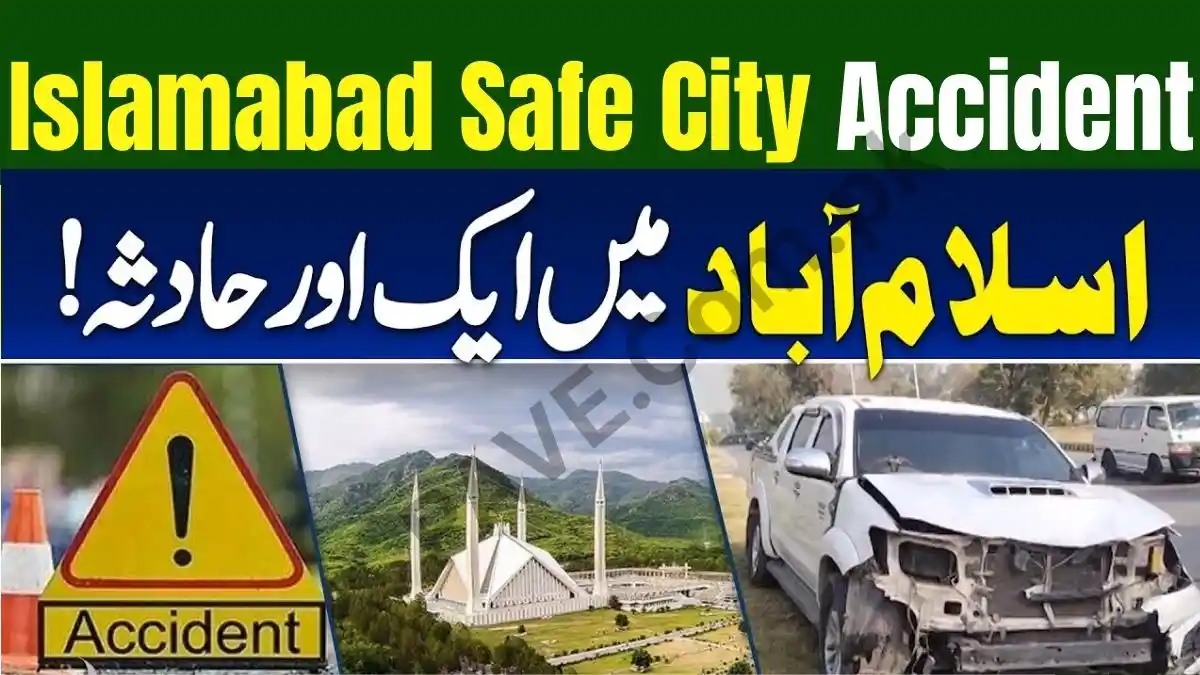
Islamabad Expressway Turns Deadly During Safe City Work
The Islamabad Expressway—one of the busiest arteries of the capital—turned into a scene of tragedy late Wednesday night after a fatal crash occurred during ongoing Safe City installation work. What should have been a carefully managed technical operation quickly transformed into a deadly incident due to the absence of basic safety measures and poor coordination between field teams and traffic authorities.
This accident has triggered a wave of public anger, exposing deeper issues within the Safe City Project’s operational practices and raising urgent questions about how such high-risk activities are being supervised.
A Routine Installation Becomes a Fatal Hazard
The incident unfolded near the I-8 checkpost toward Faizabad, where a crane had been deployed to mount new surveillance equipment under the Safe City expansion plan. Witnesses reported that the crane was stationed directly on the fast lane, with no lights, reflectors, or barriers to warn approaching vehicles.
For commuters driving at typical expressway speed, the machinery was almost invisible—especially under low visibility conditions at night.
Videos and photos circulating on social media show a dimly lit stretch of road with heavy machinery placed dangerously close to moving traffic, lacking any precautionary setup.
What was expected to improve the city’s safety infrastructure instead created a life-threatening trap.

Moments of Impact: A Double Collision
Early reports from rescue teams paint a chilling picture of the final moments before the accident.
The First Collision: Suzuki FX Hits the Crane
A Suzuki FX travelling toward Faizabad struck the crane head-on. According to investigators, the driver had virtually no reaction time because there were no advance warnings of roadwork ahead. The car’s front end absorbed the full force of the impact, leaving it severely damaged.
The Second Collision: Toyota Revo Slams Into the Wreck
Within seconds, a Toyota Revo following the same lane collided with the wrecked FX. The SUV crushed the smaller vehicle between itself and the crane, amplifying the severity of the crash.
One person died on the spot due to the violent impact.
Rescuers confirm that both vehicles were travelling at normal expressway speeds; the lack of barriers or lights left them defenseless against the obstruction.

Eyewitness Accounts Reveal Severe Negligence
Eyewitnesses were quick to point out the unsafe setup:
- No safety cones
- No flashing hazard lamps
- No reflective signs
- No police personnel guiding traffic
- No lane diversions
- No warning issued on social media or traffic advisories
One commuter who arrived minutes after the crash said,
“There was nothing—no light, no cones, no slowdown signs. You can’t put a crane on a fast lane and expect drivers to magically know it’s there.”
Another witness described the scene as “pure carelessness,” adding that even local construction teams usually follow better safety protocols than what was observed during this Safe City operation.

Safe City Team Under Fire
The Safe City Project is responsible for installing surveillance cameras and monitoring tools across Islamabad. However, this incident has put the project’s field operations under intense scrutiny.
Critics argue that the team:
- Failed to follow basic roadwork safety rules
- Did not coordinate with Islamabad Traffic Police
- Allowed heavy machinery to operate without supervision
- Ignored night-time visibility challenges
- Neglected public safety in the rush to complete installation
This is not the first time the Safe City Project has faced criticism. Faulty cameras, delayed upgrades, and inaccurate ANPR challans have frequently sparked debate. But a fatal accident marks a new level of seriousness.

Experts: “This is a System Failure”
Road safety specialists and traffic engineers have termed the accident a systemic failure, not an isolated mistake.
Experts highlight that internationally accepted guidelines—and even Pakistan’s own highway safety rules—require:
- Warning indicators placed hundreds of meters ahead
- Lane closure markers
- Reflective cones leading up to the work site
- Flashing amber lights on machinery
- Pre-announced diversions or speed reductions
Not a single one of these measures was reportedly in place.
One senior engineer said,
“Night-time roadwork without proper signaling is asking for a disaster. This tragedy was preventable.”
Public Reaction: Outrage and Calls for Accountability
The public response has been swift and intense. Social media platforms flooded with comments criticizing both the field team and the Islamabad Traffic Police for allowing such unsafe operations on a major highway.
Many describe the incident as:
- “Reckless and irresponsible”
- “An insult to road safety”
- “A failure of project management”
Some residents demanded that ongoing Safe City work be temporarily suspended until proper safety procedures are enforced. Others insisted that senior officials responsible for supervising field operations must face disciplinary action.
A trending comment read:
“Safe City? The installation itself isn’t even safe.”
Victim’s Family Demands Transparency
The family of the deceased is calling for a transparent investigation and legal action against those responsible for the unsafe setup. Lawyers familiar with traffic-related cases believe the incident may qualify as criminal negligence, given that basic precautions were completely ignored.
Human rights groups have also stepped in, urging the government to publish installation guidelines, contractor responsibilities, and safety audit reports related to the Safe City Project.
Authorities Still Silent
As of now, neither the Islamabad Traffic Police nor the Safe City administration has released a detailed public statement. The silence has further frustrated citizens, who expect immediate explanations after a fatal accident.
Analysts say the longer authorities delay, the more public trust will erode—not only in the Safe City Project but also in Islamabad’s overall traffic management system.
A Reminder of Pakistan’s Road Safety Challenges
This tragedy reflects broader issues in Pakistan’s road management framework:
- Lack of standardized safety training
- Weak oversight during construction or maintenance activities
- Limited enforcement of roadwork safety regulations
- Poor coordination between departments
Islamabad is often viewed as a model city for traffic discipline and infrastructure—but this accident reveals a glaring weakness behind the scenes.
What Comes Next?
Experts and citizens are now urging immediate action:
- A full investigation into the incident
- Identification and punishment of negligent officials
- Mandatory safety audits for all Safe City sites
- Strict enforcement of night-time roadwork protocols
- Public awareness campaigns for temporary traffic changes
If these steps are ignored, analysts warn that Islamabad may continue facing similar—and avoidable—tragedies in the future.