
Rs.13 Billion Road Projects in Rawalpindi Enter High-Speed Phase as Major Milestones Achieved
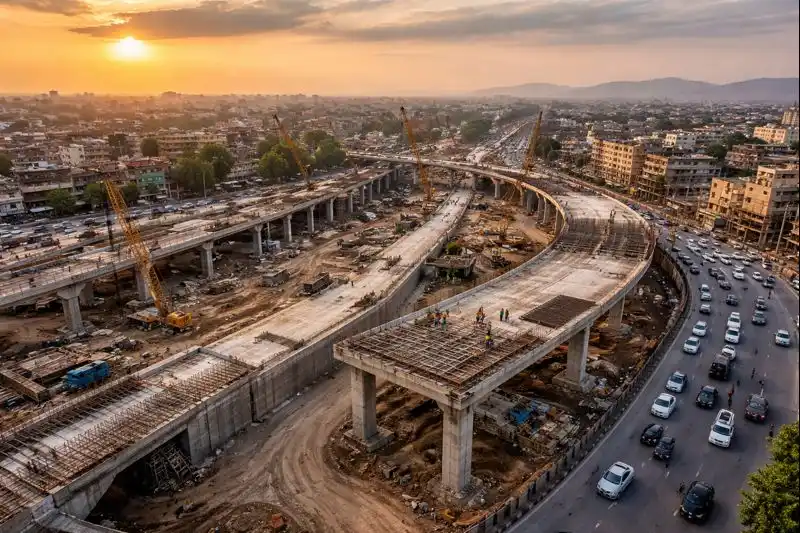
Rawalpindi’s long-awaited Road Projects upgrade has entered a high-speed construction phase as major milestones have been achieved on projects worth more than Rs.13 billion. Flyovers and underpasses at some of the city’s most congested junctions are now taking visible shape, raising hopes for smoother traffic flow and reduced travel time in the coming months.
The Punjab government has emphasized timely completion of these mega projects, which aim to resolve chronic traffic issues across Rawalpindi. With deck slabs cast, piling work nearing completion, and structural components progressing rapidly, authorities say the projects have moved into an advanced execution stage.
Rapid Progress on Kachehri Flyover and Underpasses
Construction work on the Kachehri Flyover and its associated underpasses is moving at a fast pace. Base bed stabilization, guide beam installation, and piling work are close to completion, indicating steady progress on one of Rawalpindi’s busiest traffic points.
Kachehri Chowk remains one of the city’s most congested intersections, handling heavy daily traffic from multiple directions. The new flyover and underpass system is designed to significantly reduce bottlenecks and improve vehicle movement in the area.
Authorities have directed contractors to maintain construction speed while ensuring quality and safety standards. The government has repeatedly stated that timely delivery of this project is a top priority due to its impact on daily commuters.

First Deck Slab Cast at Iftikhar Janjua Underpass
A major milestone was achieved with the casting of the first deck slab at the 567-meter-long Iftikhar Janjua Underpass. This makes it the first fully roofed structure among all ongoing road projects in Rawalpindi.
Construction teams have completed all guide beams at the site and driven 648 piles out of the total 840 required. Work on the remaining piles is continuing without interruption.
Officials say the completion of the deck slab marks a critical transition from groundwork to superstructure development. This phase allows construction activities to accelerate further, bringing the project closer to completion.

Steady Work at Kachehri Chowk Flyover
At the highly congested Kachehri Chowk, construction work continues steadily on the 878-meter-long flyover and the adjacent 530-meter underpass.
So far, all 101 piles required for the flyover have been completed, while four out of eleven pile caps have already been cast. Reinforcement work on the pier shafts is underway round the clock to maintain momentum.
In addition, guide beams on both sides of the underpass have been fully completed. Engineers believe that once structural work advances further, visible progress will increase rapidly, easing public concerns about traffic disruption during construction.

Jinnah Park Flyover Shows Strong Development
Significant progress has also been reported at the Jinnah Park Flyover, another key component of the Rs.13 billion infrastructure package.
Workers have completed all 24 piles and five pile caps for the 531-meter-long flyover. Steel fixing for the piers is currently in full swing, with teams working continuously to meet deadlines.
Meanwhile, around 70 meters of the 258-meter retaining wall have already been constructed. Most of the bed preparation and lean concrete work has also been completed, laying a solid foundation for the next stages of construction.

Major Advancement on Jinnah Park Underpass
Construction on the adjoining 480-meter Jinnah Park Underpass has also shown notable progress. Teams have completed 300 meters of guide beams and driven 391 piles out of the total 446 planned.
Additionally, 140 meters of capping beam construction has been completed, along with 120 meters of NJ barrier steel fixing. These developments indicate that the underpass is progressing steadily toward structural completion.
Once operational, the Jinnah Park flyover and underpass will play a major role in easing congestion in the surrounding commercial and recreational areas.
Creating a Signal-Free Traffic Corridor
One of the main objectives of these projects is to establish a fully signal-free corridor connecting the Islamabad Expressway with GT Road and Peshawar Road through the old Airport Road.
This corridor is expected to significantly reduce travel time for commuters moving between Rawalpindi and Islamabad, as well as those traveling toward Peshawar Road. By eliminating traffic signals at major junctions, the project aims to ensure uninterrupted vehicle flow across key routes.
Urban planners believe the signal-free corridor will also reduce fuel consumption, lower emissions, and improve overall road safety.
Official Statement on Project Acceleration
Rana Qamar Ali, Executive Engineer of the Punjab Highways Department, said that the completion of the first full deck slab and more than 70 percent of the girders on the longest flyover has pushed the project into a high-speed execution phase.
He added that the pace of development has increased significantly and that the transformation in Rawalpindi’s traffic flow will become visible in the coming months.
According to officials, multiple construction teams are working simultaneously at different sites to ensure that deadlines are met without compromising quality.
Punjab Government’s Urban Infrastructure Vision
The Punjab government launched these projects under the leadership of Chief Minister Maryam Nawaz Sharif as part of a broader urban infrastructure development initiative.
The focus of this initiative is to address severe traffic bottlenecks in major cities and improve the overall quality of urban life. Rawalpindi, being one of the province’s busiest cities, was selected as a top priority for large-scale road upgrades.
Officials say these projects reflect the government’s commitment to long-term planning rather than short-term fixes.
Key Junctions Covered Under the Mega Project
The Rs.13 billion mega project covers five major junctions that have long suffered from traffic congestion:
- Kachehri Chowk
- Iftikhar Janjua Road
- Jinnah Park Crossover
- Qasim Market on Peshawar Road
- Remodeling of Ammar Chowk
Each of these locations experiences heavy daily traffic, and their improvement is expected to deliver immediate benefits to thousands of commuters.
Expected Impact After Completion
Once completed, these schemes are expected to remove chronic congestion at major choke points across Rawalpindi. Travel times are likely to reduce significantly, especially during peak hours.
Improved traffic flow will also benefit businesses, public transport, and emergency services. Residents have expressed cautious optimism, hoping the projects will deliver long-term relief rather than temporary solutions.
Urban development experts believe that these infrastructure upgrades will also enhance Rawalpindi’s connectivity with Islamabad and surrounding regions.
Project Approval and Cost Details
The Provincial Development Working Party approved the projects with a combined cost exceeding Rs.13.334 billion. Funding has been allocated to ensure uninterrupted construction and timely completion.
Authorities have assured the public that progress is being closely monitored and that any delays will be addressed promptly.
Conclusion – Rs.13 Billion Road Projects in Rawalpindi Progress
The Rs.13 billion road projects in Rawalpindi have clearly entered a high-speed phase, with major milestones achieved across multiple sites. From the casting of deck slabs to the completion of piling and guide beams, construction activity is now moving rapidly.
Once completed, these projects are expected to transform Rawalpindi’s traffic landscape, offering smoother, faster, and safer travel for residents and visitors alike. If current momentum continues, Rawalpindi could soon witness one of its most significant urban infrastructure improvements in recent years.