
TANK 500 HEV vs PHEV Prices in Pakistan – Full Comparison & Specs
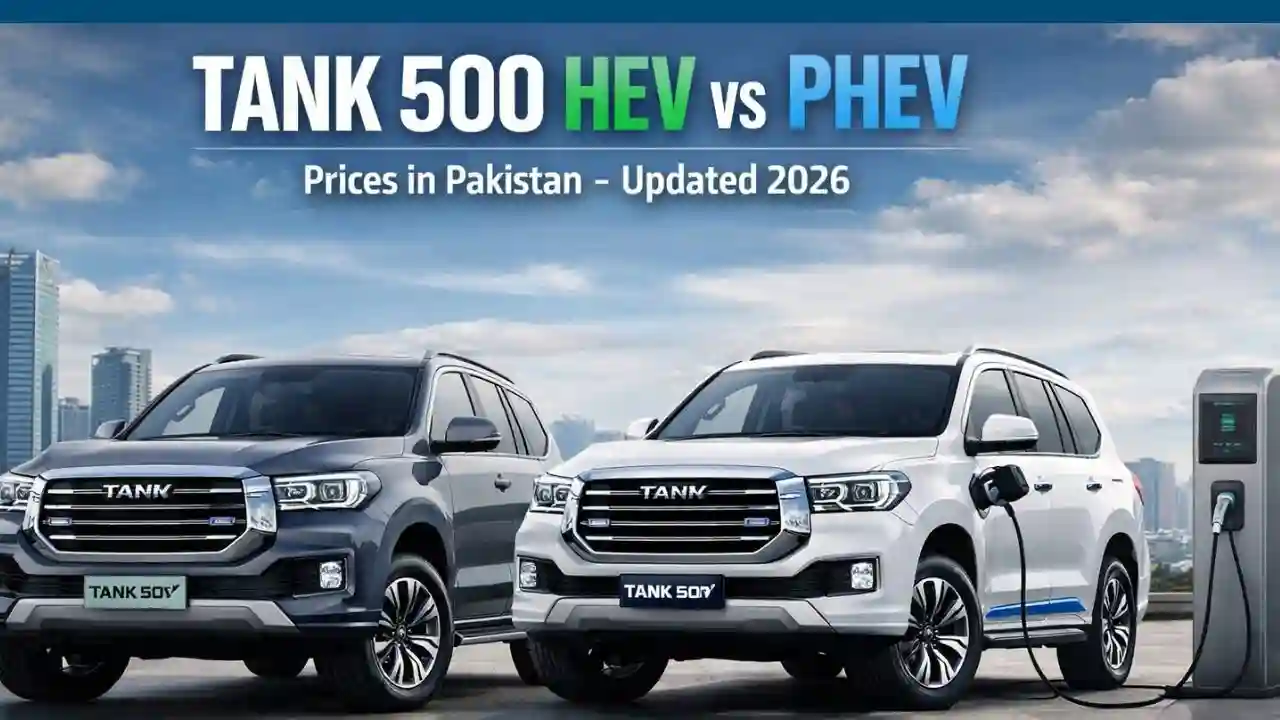
The TANK 500 HEV vs PHEV Prices in Pakistan is rapidly shifting toward hybrid and electrified vehicles, and Great Wall Motor (GWM) has entered this space strongly with the launch of the TANK 500. Available in HEV (Hybrid Electric Vehicle) and PHEV (Plug-in Hybrid Electric Vehicle) variants, the TANK 500 is positioned as a premium full-size SUV offering luxury, power, and advanced technology.
This detailed guide covers TANK 500 HEV vs PHEV prices in Pakistan, full specifications, performance, fuel efficiency, interior features, and which variant is best for Pakistani buyers in 2026.
Overview of GWM TANK 500 in Pakistan
The GWM TANK 500 is a luxury off-road SUV designed to compete with high-end Japanese and European SUVs. Unlike traditional petrol or diesel SUVs, TANK 500 uses hybrid technology, reducing fuel consumption while maintaining strong performance.
In Pakistan, the TANK 500 is offered in two variants:
- TANK 500 HEV (Hybrid Electric Vehicle)
- TANK 500 PHEV (Plug-in Hybrid Electric Vehicle)
Both variants are locally assembled (CKD), which helps control pricing and improves parts availability.

TANK 500 HEV vs PHEV Prices in Pakistan (2026 Updated)
Here are the latest ex-factory prices in Pakistan:
| Variant | Price (PKR) | Seating Capacity |
|---|---|---|
| TANK 500 HEV | 20,500,000 | 7-Seater |
| TANK 500 PHEV | 22,500,000 | 5-Seater |
📌 Important Note:
These are ex-factory prices. Registration, withholding tax, freight, and on-road charges are not included.
The PHEV is around PKR 2 million more expensive due to its larger battery, plug-in charging system, and higher power output.

HEV vs PHEV – What’s the Real Difference?
Understanding the difference between HEV and PHEV is important before buying.
HEV (Hybrid Electric Vehicle)
- Cannot be charged externally
- Battery charges automatically through engine and braking
- Uses petrol and electric power together
- Better fuel efficiency than normal petrol SUVs
PHEV (Plug-in Hybrid Electric Vehicle)
- Can be charged via home or public charger
- Offers real electric-only driving
- Uses petrol engine only when battery is low
- Lower fuel cost for city use
👉 In short: HEV is simpler, while PHEV is more advanced and efficient if charged regularly.

Engine & Performance Comparison
Both variants use a 2.0L turbocharged petrol engine, but power delivery is different.
| Specification | TANK 500 HEV | TANK 500 PHEV |
|---|---|---|
| Engine | 2.0L Turbo Hybrid | 2.0L Turbo Plug-in Hybrid |
| Max Power | ~342 HP | ~402 HP |
| Max Torque | ~648 Nm | ~750 Nm |
| Transmission | 9-Speed Automatic | |
| Drive System | AWD (All-Wheel Drive) | |
| 0–100 km/h | ~7.9 sec | ~6.9 sec |
🔹 Performance Verdict:
The PHEV is noticeably quicker and more powerful, especially during acceleration and overtaking.

Battery & Electric Range
TANK 500 HEV
- Small hybrid battery
- No pure electric driving for long distances
- Focuses on fuel efficiency and smooth driving
TANK 500 PHEV
- Large lithium-ion battery
- Electric-only range: up to 110–120 km
- Ideal for daily city commuting without petrol
This makes the PHEV far cheaper to run if you charge it daily.
Fuel Efficiency Comparison
| Driving Type | HEV | PHEV |
|---|---|---|
| City | 12–14 km/l | Mostly electric |
| Highway | 11–13 km/l | 18+ km/l (hybrid mode) |
| Daily Commute | Moderate savings | Maximum savings |
✅ Winner:
- HEV: Better for users who don’t want charging
- PHEV: Best for fuel savings in cities
Dimensions & Body Size
Both variants share the same strong and muscular body design.
- Length: 5,078 mm
- Width: 1,934 mm
- Height: 1,905 mm
- Wheelbase: 2,850 mm
- Ground Clearance: High (SUV & off-road friendly)
Seating Difference
- HEV: 7 seats (better for families)
- PHEV: 5 seats (more comfort & luggage space)
Interior & Luxury Features
Both TANK 500 variants offer premium interior quality.
Common Features
- Panoramic sunroof
- Large digital instrument cluster
- Touchscreen infotainment system
- Wireless charging
- 360-degree camera
- Adaptive cruise control
- Leather seats
- Dual-zone climate control
- Multiple driving modes (Eco, Sport, Off-road)
The interior feel is luxury-oriented, making it competitive with SUVs costing much more.
Safety Features
- 6+ airbags
- ABS & EBD
- Traction control
- Hill descent control
- Lane assist
- Blind-spot monitoring
- Emergency braking system
The TANK 500 meets modern international safety standards.
Pros & Cons Comparison
TANK 500 HEV – Pros
✔ Lower price
✔ 7-seater family SUV
✔ No charging required
✔ Reliable hybrid system
TANK 500 HEV – Cons
✘ No electric-only driving
✘ Slightly lower performance
TANK 500 PHEV – Pros
✔ Strongest performance
✔ Electric-only driving up to 120 km
✔ Very low fuel cost
✔ Advanced technology
TANK 500 PHEV – Cons
✘ Higher price
✘ Only 5 seats
✘ Requires charging setup
Which TANK 500 Should You Buy in Pakistan?
Buy TANK 500 HEV if:
- You want a 7-seater SUV
- You don’t want charging hassle
- You prefer lower upfront cost
Buy TANK 500 PHEV if:
- You drive mostly in cities
- You can charge at home
- You want maximum power & efficiency
FAQs – TANK 500 HEV vs PHEV Pakistan
Q1: What is the price difference between HEV and PHEV?
About PKR 2 million.
Q2: Can TANK 500 PHEV run without petrol?
Yes, for daily city use within electric range.
Q3: Which variant is better for families?
The HEV, because it offers 7 seats.
Q4: Is PHEV expensive to maintain?
No, maintenance cost is lower due to reduced engine usage.
Q5: Is TANK 500 suitable for off-road use?
Yes, both variants have AWD and off-road driving modes.
Final Verdict
The TANK 500 HEV vs PHEV debate depends on your lifestyle. The HEV is practical, family-friendly, and more affordable, while the PHEV delivers top-level performance, electric driving, and long-term fuel savings.
Both models bring luxury, technology, and power to Pakistan’s SUV market, making the TANK 500 one of the most advanced hybrid SUVs available in 2026.