Security Features of Pakistan New Currency Notes – How to Identify Original Notes
Fake currency circulation remains a serious concern in Pakistan, especially in busy markets, public transport areas, and during shopping seasons. Many people unknowingly accept counterfeit notes because they do not know how to check original currency.
To solve this problem, the State Bank of Pakistan (SBP) introduced upgraded security features in Pakistani currency notes. These features make it harder to copy notes and easier for the public to verify authenticity.
In this guide, we will explain the security features of Pakistan’s currency notes in simple terms so anyone can identify genuine notes easily.
Why Understanding Currency Security Matters
Every day, millions of currency notes exchange hands across Pakistan. Shopkeepers, drivers, students, and salaried workers all rely on cash transactions.
If fake currency spreads:
- Businesses suffer losses.
- Public trust in cash reduces.
- Crime networks benefit.
- Ordinary citizens lose money.
Knowing how to check notes protects your money and helps stop counterfeit circulation.
Brief News Summary on Currency Security Updates
In recent years, SBP has upgraded printing standards and added modern anti-counterfeit features to Pakistani banknotes. These improvements aim to match international currency standards and reduce fake note circulation.
Authorities regularly advise citizens to check notes carefully and report suspicious currency to banks.
Common Denominations in Circulation
Currently, Pakistani currency notes commonly used include:
- Rs. 10
- Rs. 20
- Rs. 50
- Rs. 100
- Rs. 500
- Rs. 1000
- Rs. 5000
All denominations include multiple security features, though higher-value notes contain more advanced protection elements.
Major Security Features in Pakistan Currency Notes
Let us now look at each feature that helps identify original notes.
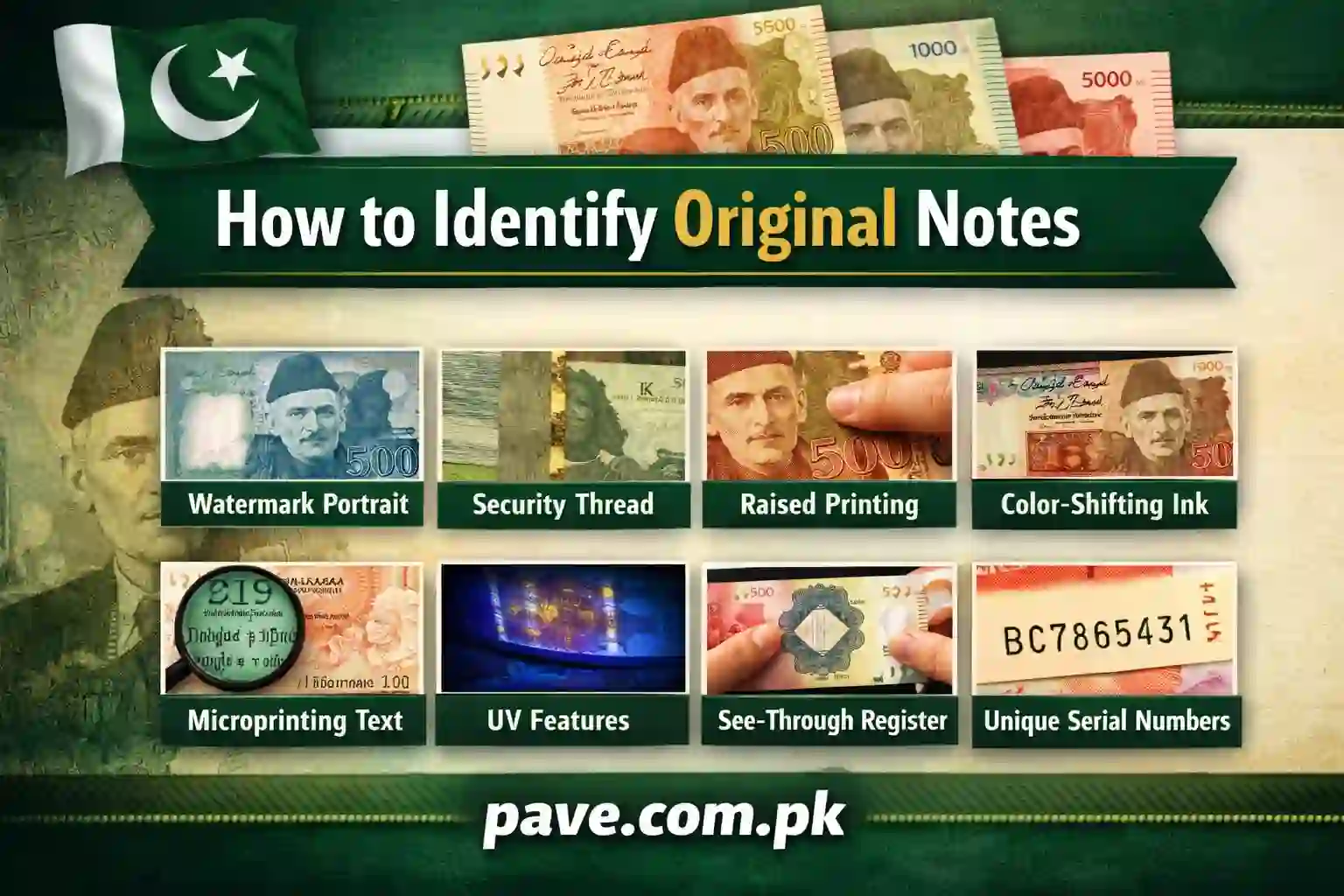
Watermark Portrait
One of the easiest ways to verify a note is the watermark.
When you hold a note against light, you will see:
- Portrait of Quaid-e-Azam
- Denomination value
- Light and shadow patterns
This watermark is inside the paper, not printed on top. Fake notes usually fail to replicate this clearly.
Tip: Always check watermark under light.
Security Thread
A thin metallic strip runs vertically inside original notes.
When held under light:
- The thread becomes visible.
- Denomination text appears on the strip.
- It looks embedded, not pasted.
Fake notes often print a line instead of embedding a real thread.
Raised Printing Texture
Original Pakistani notes have raised printing that can be felt by touch.
You can feel raised texture on:
- Quaid-e-Azam portrait
- Currency value numbers
- Urdu text
- Main design areas
Counterfeit notes usually feel flat and smooth.
Tip: Rub your finger across the portrait area.
Color-Shifting Ink
High-value notes like Rs. 500, Rs. 1000, and Rs. 5000 include color-changing ink.
When you tilt the note:
- Color of the denomination changes.
- Shade shifts between green and gold tones.
Fake notes usually have fixed color that does not change.
Microprinting Text
Small text printed in very fine detail appears on genuine notes.
You may need a magnifying glass to see:
- Tiny denomination text
- Small printed patterns
Counterfeit notes often blur or miss this detail.
See-Through Register
Some parts of the design are printed on both sides of the note.
When held against light:
- Both sides combine to form a complete number or pattern.
Fake notes usually fail to align properly.
Fluorescent Features Under UV Light
Banks use ultraviolet machines to check notes.
Under UV light:
- Specific fibers glow.
- Certain patterns become visible.
- Serial numbers shine.
Fake notes often lack these glowing elements.
Unique Serial Numbers
Every note has a unique serial number.
Check for:
- Proper alignment
- Uniform printing
- Same color shade
- Equal spacing
Counterfeit notes sometimes show uneven printing or repeated serial numbers.
Latent Image Feature
When viewing the note at eye level and tilting slightly, hidden numbers become visible.
This feature is usually present in higher denominations.
Fake notes usually miss this subtle effect.

Quick Method to Check Currency in Daily Life
You do not need machines or tools for daily checking. Use this simple three-step method:
Step 1: Feel
Check raised printing texture.
Step 2: Look
Hold note under light to see watermark and thread.
Step 3: Tilt
Check color change and hidden images.
This quick check works well in markets or shops.

Common Signs of Fake Currency
Watch out for these warning signs:
- Paper feels very smooth or very thick.
- Colors look dull or overly bright.
- Watermark unclear or missing.
- Security thread looks printed.
- Serial numbers look uneven.
- Design appears blurred.
- No color change when tilted.
If multiple signs appear, the note may be fake.
What to Do If You Receive a Fake Note
If you suspect a counterfeit note:
- Do not try to pass it to someone else.
- Take it to the nearest bank branch.
- Inform bank officials.
- Provide details if required.
Passing fake currency knowingly is a punishable offense.
Tips for Shopkeepers and Cash Handlers
People handling cash daily should:
- Use UV checking machines.
- Train staff in note verification.
- Check high-value notes carefully.
- Avoid accepting damaged or suspicious notes.
- Deposit cash regularly in banks.
Training employees reduces business losses.
How Pakistan’s Currency Security Compares Globally
Modern Pakistani notes include security features similar to international standards:
- Watermarks
- Security threads
- Color-shifting ink
- UV features
- Microprinting
Continuous upgrades ensure better protection against advanced counterfeit techniques.
Future of Currency Security in Pakistan
Central banks worldwide are moving toward:
- Polymer notes
- Advanced holograms
- Enhanced anti-copy technology
- Digital payment expansion
Pakistan may also introduce improved currency designs or polymer notes in future to further reduce counterfeiting.
However, cash will remain important for many years, especially in rural and semi-urban areas.
Public Awareness Is the Best Protection
Technology alone cannot stop fake currency. Public awareness is equally important.
If citizens know how to check notes:
- Counterfeit circulation reduces.
- Criminal networks fail.
- Businesses remain protected.
- Public confidence increases.
Every citizen plays a role in currency security.
Conclusion – Security Features of Pakistan New Currency Notes
Pakistan’s new currency notes include multiple advanced security features designed to protect the economy and citizens from counterfeit currency.
By learning simple checking methods like examining watermarks, feeling raised printing, and observing color changes, anyone can easily identify original notes.
Always stay alert when receiving cash, especially high-value notes. If something looks suspicious, verify it immediately.