Government Suspends Net Billing Shift Amid Solar Policy Controversy
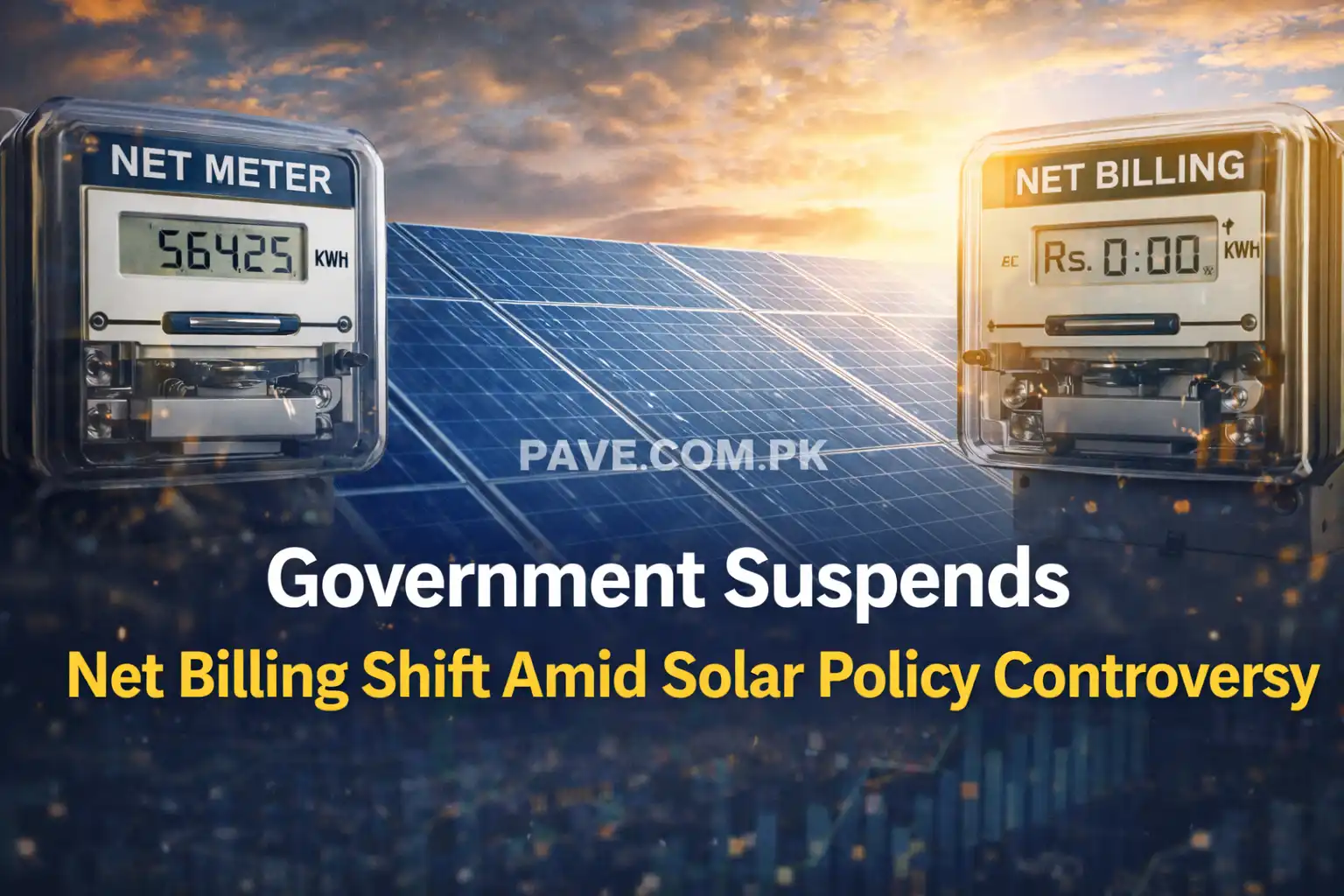
The federal government has officially stopped the implementation of the new solar policy, which proposed shifting consumers from net metering to net billing, after facing strong political and public backlash.
The decision was announced in the National Assembly, where Federal Minister for Power Division Awais Leghari said the government has also decided to file an appeal against the regulator’s decision.
This development has sparked nationwide debate about Pakistan’s solar energy policy, electricity tariffs, net metering rules, circular debt, and power sector reforms.
In this detailed article, we explain everything in easy English with proper headings and important Google search keywords.
What Was the New Solar Policy?
The government had planned to shift solar consumers from:
- Net Metering System → to → Net Billing System
What Is Net Metering?
Under net metering:
- Solar consumers can sell excess electricity back to the grid.
- The government buys solar electricity at around Rs. 27 per unit.
- Consumers receive credit on their electricity bills.

What Is Net Billing?
Under net billing:
- Exported electricity is purchased at a lower rate.
- Consumers may not receive equal compensation for excess power.
- The system is less financially beneficial compared to net metering.
The proposed change triggered widespread criticism from:
- Solar consumers
- Renewable energy supporters
- Political opposition
- Industry stakeholders
As a result, the government halted implementation.
Why Did the Government Stop the Policy?
According to Power Minister Awais Leghari, the criticism must be seen in the broader context of power sector reforms.
However, due to rising public pressure, the government:
- Stopped implementation
- Ordered an appeal against the regulator
- Decided to review the matter further
The issue became politically sensitive because nearly 700,000 consumers are currently on net metering.
Solar Power in Pakistan – Current Numbers
The minister revealed key figures:
- Total solar capacity: 20,000 to 22,000 MW
- Net metering capacity: 6,000 to 7,000 MW
- Industrial & commercial solar: 7,000 MW
- Off-grid solar capacity: 12.62 MW
- Net metering consumers: 700,000
- Total electricity consumers: 39.22 million
This means only about 8% to 10% of consumers benefit from net metering.
Government’s Argument: Is Net Metering Fair?
The minister questioned:
Is it fair for the government to buy electricity at Rs. 27 per unit when it receives power from other sources at around Rs. 8 per unit?
He emphasized that:
- 35 million consumers are NOT on net metering.
- The policy benefits a small segment of consumers.
- The burden may fall on ordinary users.
This fairness debate is central to the controversy.
Power Sector Reforms – What the Government Claims
Minister Awais Leghari highlighted major reforms:

1. Circular Debt Reduction
- Circular debt reduced by Rs. 780 billion
- Consumers pay Rs. 310 billion annually to service circular debt
2. IPP Renegotiations
- Agreements with Independent Power Producers (IPPs) renegotiated
- Total relief of Rs. 3,400 billion
- Rs. 100 billion reduction from a project linked to the Prime Minister’s relative
- 7,967 MW high-cost projects cancelled

3. Industrial Electricity Tariff Reduction
Electricity prices for industrial consumers have been reduced to:
- Support economic growth
- Boost exports
- Encourage manufacturing
Load Shedding Situation in Pakistan
During the National Assembly session, the Power Division revealed serious load shedding figures.
Out of 12,665 feeders nationwide:
- 2,223 feeders face more than 10 hours of load shedding
Worst Affected Areas:
- Quetta Electric Supply Company (QESCO): 604 feeders
- Sukkur Electric Power Company (SEPCO): 407 feeders
- Tribal Areas Electric Supply Company (TESCO): 174 feeders
- Peshawar Electric Supply Company (PESCO): 642 feeders
Areas with No 10+ Hour Load Shedding:
- Lahore Electric Supply Company (LESCO)
- Islamabad Electric Supply Company (IESCO)
- Gujranwala Electric Power Company (GEPCO)
- Faisalabad Electric Supply Company (FESCO)
This highlights uneven electricity distribution challenges across Pakistan.
Transmission Losses – A Major Concern
Transmission losses over two years exceeded Rs. 600 billion:
- FY24: Rs. 322 billion
- FY25: Rs. 284 billion
Company-wise losses:
- PESCO: Rs. 96 billion
- QESCO: Rs. 51 billion
- LESCO: Rs. 46 billion
- SEPCO: Rs. 37 billion
- HESCO: Rs. 22 billion
These losses contribute heavily to circular debt and electricity tariff increases.
Political Pressure and Public Reaction
The proposed solar policy shift triggered:
- Public protests on social media
- Criticism from solar installers
- Opposition party objections
- Concerns from middle-class households
Many urban areas like Islamabad’s F and G sectors have high solar adoption, while suburban areas like Burma Town have fewer net metering users.
This created a debate about whether the policy mainly benefits wealthier urban residents.
Impact on Solar Industry
If net billing had replaced net metering:
- Solar installation growth could slow down
- Return on investment period would increase
- Consumer confidence in renewable energy may decline
Pakistan has seen rapid growth in rooftop solar due to:
- High electricity prices
- Load shedding
- Falling solar panel costs
Policy uncertainty could affect the renewable energy market.
Broader Energy Sector Context
Pakistan’s power sector faces multiple challenges:
- Circular debt
- Transmission losses
- High capacity payments
- Load shedding
- Rising fuel costs
At the same time, renewable energy is critical for:
- Reducing fuel imports
- Lowering electricity cost
- Meeting climate goals
Balancing affordability and sustainability remains difficult.
What Happens Next?
The government has:
- Halted implementation
- Filed appeal against regulator
- Promised further review
Possible outcomes:
- Modified net metering rates
- Gradual shift to net billing
- Hybrid compensation model
- Policy compromise after consultations
Final decision will impact millions of consumers and the solar industry.
Key Google Search Keywords Covered
This article includes high-search keywords such as:
- Pakistan solar policy 2026
- Net metering vs net billing Pakistan
- Govt stops new solar policy
- Awais Leghari statement
- Circular debt Pakistan
- IPP tariff reduction
- Load shedding Pakistan 2026
- Solar capacity Pakistan megawatts
- Electricity tariff update Pakistan
Conclusion
The government’s decision to stop the implementation of the new solar policy shows how sensitive energy reforms can be in Pakistan.
While the government argues about fairness and cost balance, critics believe renewable energy growth should not be discouraged.
The coming weeks will be crucial in determining the future of:
- Net metering in Pakistan
- Solar energy expansion
- Electricity pricing reforms
This issue highlights the broader challenge of balancing economic stability with clean energy development.