How Pakistan’s EV Shift Can Save Billions in Fuel Imports
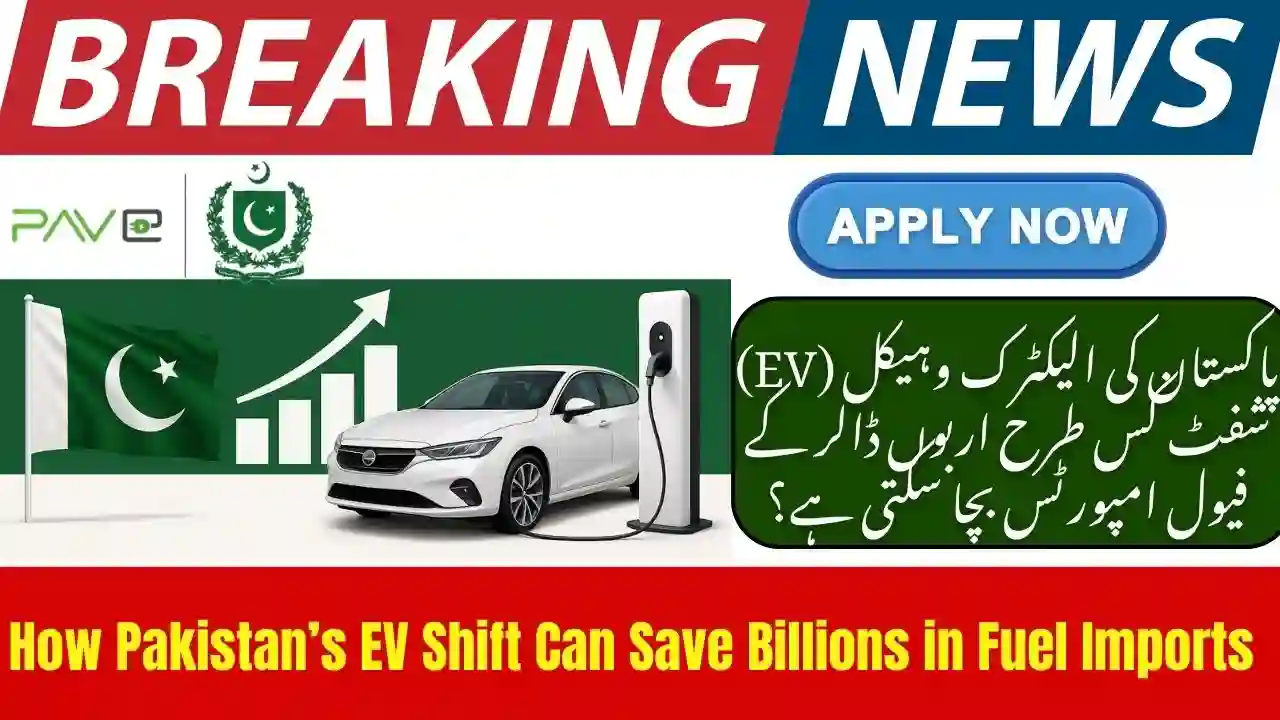
Pakistan EV Shift Save Fuel Imports is one of the biggest contributors to fuel consumption, economic pressure, and rising import bills. With global crude oil prices increasing and Pakistan’s heavy dependency on imported petroleum products, the country faces a yearly burden of billions of dollars in fuel imports. In this situation, Pakistan’s EV shift—the transition to electric vehicles—has emerged as one of the most strategic, cost-saving, and environmentally friendly solutions.
Pakistan imports more than 85% of its total fuel requirement, and the transport sector consumes around 60–70% of this imported fuel. As a result:
- Fuel import bills cross $25–30 billion annually
- The trade deficit widens
- Rupee depreciation worsens
- Inflation increases
- Public transport becomes unaffordable
Electric vehicles (EVs) provide a game-changing alternative. With lower running costs, zero petrol consumption, and the ability to run on locally generated electricity, Pakistan’s EV shift can significantly cut fuel imports.
Pakistan’s Fuel Import Crisis – Key Stats and Economic Pressure (2025)
To understand the importance of EV adoption, it’s essential to analyze the current fuel import situation.
Key Fuel Import Statistics:
- Pakistan spends $20–25 billion every year on petroleum imports.
- Transport sector alone consumes 15–17 million tons of oil annually.
- Rising demand and weak currency make fuel even more expensive.
- International oil price increases directly hit Pakistan.
Economic Impact of High Fuel Imports:
- Widened current account deficit
- Pressure on foreign exchange reserves
- Rising electricity and transportation charges
- Increased inflation for common citizens
Given this severe economic situation, transitioning to electric vehicles is not optional—it is necessary.
How Pakistan’s EV Shift Can Save Billions in Fuel Imports
Here is the most important part of the analysis. If Pakistan switches even 30–50% of its vehicles to electric by 2030, it can save billions in fuel imports.

1 EVs Reduce Dependence on Imported Petrol & Diesel
Electric vehicles run on electricity—not fuel. Since Pakistan produces a large part of its electricity domestically (hydro, solar, coal, LNG, wind), using EVs reduces dependency on imported petroleum products.
Estimated Savings:
- Replacing 100,000 petrol bikes with e-bikes:
Save $65–70 million annually. - Replacing 20,000 petrol cars with EV cars:
Save $50–60 million annually. - Replacing 10,000 rickshaws with e-rickshaws:
Save $25–30 million annually. - Replacing 5,000 diesel buses with electric buses:
Save $140–150 million annually.
Total possible saving: $300 million per year in early adoption alone.
With nationwide adoption, billions in savings become possible.

Electricity Is Cheaper Than Fuel – Cost Comparison (2025)
Cost of 1 km on Petrol Vehicle:
- Average petrol cost per km: Rs. 15–20
Cost of 1 km on Electric Vehicle:
- Running cost per km: Rs. 2–3
This difference creates massive savings for individuals and the national economy.

Pakistan’s EV Policy 2020–2025 – Government Efforts to Reduce Fuel Imports
The Government of Pakistan introduced an EV policy with multiple incentives:
Key features include:
- Lower import duty on EVs
- Sales tax reduced to 1%
- Zero customs duty on EV chargers
- Duty-free import of EV batteries
- Incentives for local assembly plants
- Duty exemptions for CKD (completely knocked down) EV units
These policies aim to shift:
- 30% of passenger vehicles
- 50% of two-wheelers
- 50% of three-wheelers
- 90% of public transport
to electric mobility by 2030.
If achieved, Pakistan can save $6–8 billion annually in fuel imports.
How EVs Improve Pakistan’s Energy Security & Payment Balance
Pakistan faces continuous pressure on foreign exchange reserves because of heavy fuel imports. EV adoption will:
- Reduce dollar outflow
- Stabilize the rupee
- Improve payment balance
- Reduce reliance on oil-importing countries
- Strengthen local energy generation
Switching to EVs does not just reduce fuel demand—it protects Pakistan from global oil price shocks.
Local Production of EVs Can Save Even More
If Pakistan focuses on local EV manufacturing, it can:
- Create a multi-billion-rupee industry
- Reduce imports of entire EV units
- Lower car prices
- Increase employment
- Encourage tech innovation
Local companies like Sazgar, Jolta, Road Prince, DFSK, and MG have already started EV initiatives.
Local manufacturing reduces imports and strengthens the economy even further.
EV Charging Infrastructure – How It Reduces Fuel Demand
Expanding EV charging stations can significantly reduce petrol dependency.
Government Plans Include:
- Highway charging corridors
- Fast chargers in major cities
- Solar-powered charging stations
- EV chargers in metro stations
- Public–private partnerships
Using solar charging stations means zero cost fuel and huge national savings.
Economic Benefits of EV Adoption in Pakistan
Here are the major economic benefits:
✔ Fuel import savings
Billions saved per year.
✔ Reduced maintenance costs
EVs have fewer moving parts.
✔ Lower transport costs for citizens
Cheaper commute boosts economic activity.
✔ Growth of new industries
Battery manufacturing, EV parts, charging hardware.
✔ Foreign investment
Global automakers invest in EV-friendly environments.
✔ Environmental savings
Reduced pollution saves billions in health costs.
Challenges in Pakistan’s EV Shift (2025)
Despite the benefits, there are challenges:
1. Lack of Charging Infrastructure
Nationwide charging stations still limited.
2. High Initial Cost of EV Cars
EVs remain expensive for middle-class buyers.
3. Battery Replacement Cost
Lithium-ion batteries are expensive but prices are falling globally.
4. Lack of Local Manufacturing
Heavy reliance on imported EV units.
5. Policy Delays & Inconsistency
Frequent changes discourage investors.
Solving these issues will allow Pakistan to maximize fuel savings.
11. Future of Pakistan’s EV Revolution – 2030 Outlook
By 2030, Pakistan can achieve:
- 50% electric 2-wheelers
- 35% electric cars
- 60% electric rickshaws
- 40% electric buses
This transformation will reduce fuel imports by $8–10 billion annually, improving national finances significantly.
Read Also: POCO F8 Ultra Spotted on Geekbench – Confirms Chipset, RAM & Android Version
Conclusion – Why EV Shift Is Pakistan’s Economic Lifeline
The shift to electric vehicles is not just an environmental necessity—it is Pakistan’s best economic opportunity. By reducing fuel imports, stabilizing the rupee, lowering transport costs, and creating new industries, EV adoption can unlock billions in national savings.
If Pakistan remains consistent with its EV policies, invests in charging infrastructure, and promotes local manufacturing, the country can achieve financial independence, energy security, and sustainable growth.
FAQs – How Pakistan’s EV Shift Can Save Billions in Fuel Imports:
1. How much can Pakistan save by shifting to EVs?
Pakistan can save $6–10 billion annually if EV adoption reaches large scale.
2. Are electric bikes the best solution to reduce fuel imports?
Yes. Pakistan has over 28 million motorcycles. Replacing even 30% with e-bikes saves hundreds of millions of dollars.
3. Are EVs cheaper to run than petrol vehicles?
Yes. EV running cost is Rs. 2–3 per km, while petrol costs Rs. 15–20 per km.
4. Can solar energy help EV adoption?
Yes. Solar-powered charging stations provide free, clean energy and reduce fuel dependency.
5. What is the biggest challenge in Pakistan’s EV transition?
Lack of nationwide charging network and high initial EV cost.
6. Will EV batteries become cheaper by 2030?
Globally, battery prices are falling every year. By 2030, EVs will be significantly cheaper.