
Pakistan Gas Prices Increase as OGRA Revises RLNG Rates for March 2026
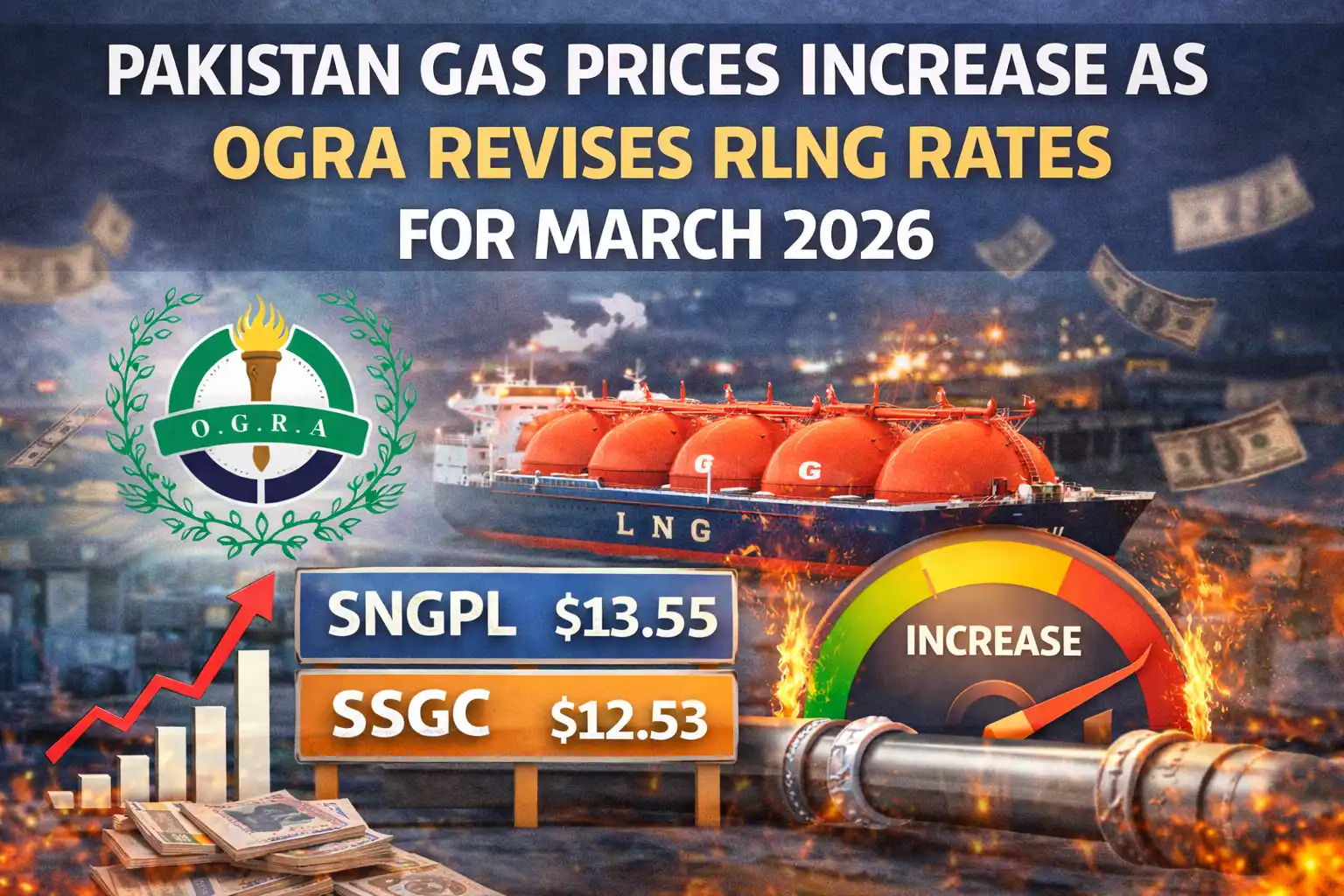
The Oil and Gas Regulatory Authority (OGRA) has announced an increase in Re-gasified Liquefied Natural Gas (RLNG) prices for March 2026, reflecting rising international LNG prices and higher import-related costs. The revised rates came into effect from March 1, 2026, in accordance with the pricing policy guidelines issued by the Government of Pakistan.
The increase in RLNG prices will affect consumers connected to both Sui Northern Gas Pipelines Limited (SNGPL) and Sui Southern Gas Company Limited (SSGCL) networks.
According to OGRA, the new RLNG prices are significantly higher than the rates announced for February 2026 due to increased Delivered Ex-Ship (DES) LNG prices, higher terminal charges, and rising import costs.

What Is RLNG and Why It Is Important for Pakistan
Re-gasified Liquefied Natural Gas (RLNG) is imported LNG that is converted back into gas form after arriving at LNG terminals.
Pakistan imports LNG to address the shortage of domestic natural gas production.
RLNG is widely used in:
- Power generation plants
- Industrial sectors
- Fertilizer production
- Commercial energy consumption
Because Pakistan relies heavily on imported LNG to meet its energy needs, fluctuations in international LNG prices directly impact local gas prices.
New RLNG Prices for March 2026
The revised RLNG prices for March 2026 have increased for both transmission and distribution categories.
RLNG Prices for SNGPL Consumers
For consumers served by Sui Northern Gas Pipelines Limited, OGRA has set the following RLNG rates:
- Transmission price: $12.4913 per MMBtu
- Distribution price: $13.5516 per MMBtu
In comparison, February prices were:
- Transmission: $10.4686 per MMBtu
- Distribution: $11.3345 per MMBtu
This represents a noticeable increase in RLNG costs for consumers in northern regions of Pakistan.
RLNG Prices for SSGCL Consumers
For consumers connected to Sui Southern Gas Company Limited, the new prices are:
- Transmission price: $11.0169 per MMBtu
- Distribution price: $12.5354 per MMBtu
The February prices for SSGCL consumers were:
- Transmission: $9.0301 per MMBtu
- Distribution: $10.2704 per MMBtu
This increase will mainly affect industries and power plants operating in southern regions of the country.
Reasons Behind RLNG Price Increase
OGRA explained that several factors contributed to the increase in RLNG prices for March 2026.
Higher International LNG Prices
Global LNG prices have been rising due to increased demand and supply disruptions in international energy markets.
Pakistan imports LNG under long-term contracts as well as spot market purchases, making prices sensitive to international fluctuations.
Increased Delivered Ex-Ship (DES) Prices
The Delivered Ex-Ship (DES) price refers to the cost of LNG delivered to Pakistan’s ports.
Higher DES prices significantly increase the overall cost of imported LNG.
Terminal Charges and Import Costs
Additional costs related to LNG terminals, shipping, and handling also contribute to the final RLNG price.
These charges include:
- Terminal processing fees
- Storage and regasification costs
- Transportation and pipeline expenses
All these components are included in the RLNG pricing mechanism.
Impact of RLNG Price Increase on Industries
Higher RLNG prices can have a direct impact on Pakistan’s industrial sector.
Many industries rely heavily on natural gas and RLNG as their primary energy source.
Industries that may be affected include:
- Textile manufacturing
- Fertilizer production
- Steel and cement industries
- Food processing plants
Rising energy costs can increase production expenses, which may eventually affect consumer prices.
Impact on Electricity Generation
RLNG is widely used in Pakistan’s power plants to generate electricity.
When RLNG prices increase, electricity generation costs also rise.
This can lead to:
- Higher electricity tariffs
- Increased circular debt in the power sector
- Greater financial pressure on power companies
Energy policymakers must carefully manage these price changes to maintain electricity affordability.
Pakistan’s Dependence on LNG Imports
Pakistan began importing LNG to address the gap between domestic gas production and energy demand.
Domestic gas reserves have been gradually declining, forcing the country to rely more on imported LNG.
Key reasons for LNG imports include:
- Growing energy demand
- Declining local gas production
- Industrial energy requirements
- Power generation needs
Because of this dependence, international LNG price fluctuations have a direct impact on Pakistan’s energy costs.
Government Policy on RLNG Pricing
RLNG prices in Pakistan are determined monthly based on import costs and government pricing policies.
The Oil and Gas Regulatory Authority calculates RLNG prices using several factors, including:
- LNG import contract prices
- Shipping costs
- Regasification charges
- Pipeline transportation costs
These prices are then announced officially through OGRA notifications.
Global Energy Market Trends
International energy markets have experienced significant volatility in recent years.
Factors influencing LNG prices include:
- Global geopolitical tensions
- Supply disruptions
- Seasonal demand changes
- Energy policies of major economies
Countries that rely on energy imports often face price fluctuations as a result of these global trends.
Possible Economic Effects
Higher RLNG prices may have broader economic implications for Pakistan.
These effects may include:
- Increased production costs for industries
- Potential rise in electricity tariffs
- Higher inflation due to increased manufacturing costs
Energy price stability remains a major challenge for policymakers.
Future Outlook for Gas Prices in Pakistan
Energy experts believe that LNG prices may continue to fluctuate depending on global market conditions.
Pakistan may need to adopt long-term energy strategies to reduce reliance on imported fuels.
Possible strategies include:
- Expanding renewable energy projects
- Increasing domestic gas exploration
- Improving energy efficiency
- Diversifying energy sources
These steps could help stabilize energy prices in the long term.
Conclusion
The increase in RLNG prices for March 2026 reflects rising international LNG costs and higher import-related expenses.
With the new pricing announced by the Oil and Gas Regulatory Authority, both SNGPL and SSGCL consumers will face higher RLNG rates compared to February.
While the adjustment follows the government’s pricing policy, it highlights the challenges Pakistan faces due to its reliance on imported energy.
Managing rising energy costs while maintaining economic stability will remain a key priority for policymakers in the coming months.